




Breve historia de Emanuel - Oficial
Un domingo por la mañana en la Iglesia Metodista de San Jorge, en Filadelfia, Pensilvania, durante el otoño de 1787, tras negarse a ser otra víctima de discriminación racial, el reverendo Richard Allen se retiró de San Jorge. Compró una herrería vieja y destartalada. La trasladó a un terreno que había adquirido en las calles Sexta y Lombard, donde fundó una Iglesia Metodista independiente, que se convirtió en Bethel. La asoció con la Sociedad Africana Libre, no sectaria, que había fundado el año anterior para fomentar el carácter moral y ayudar a sus miembros en momentos de necesidad. Cuando fundó la iglesia, era una Iglesia Metodista para africanos. Dado que la Iglesia Metodista buscaba controlar la iglesia que Allen había fundado, se separó de la Iglesia Metodista y, el 9 de mayo de 1816, fundó la Iglesia Episcopal Metodista Africana.
The Reverend Morris Brown, who later became the second bishop of the AME Church, and other African- American ministers and laymen, seceded from the Methodist Church in Charleston due to the cancellation of the few privileges they were given within the church. Brown and about 1,000 followers became the core of Charleston African Church movement. He then sought to have it affiliated with the Reverend Allen African Church movement in Philadelphia. On July 15, 1818, he connected his Charleston church with Richard Allen African Methodist Episcopal. Charlestonians organized several meeting houses. Eventually, they built a church in the Hampstead suburb of Charleston at Reid and Hanover Streets.
Denmark Vesey was an active member of the Hampstead congregation. He and his master, Captain Joseph Vesey, relocated to Charleston in the late 1790s. Vesey had traveled extensively and was multilingual. In 1799, he won $1500 from a local lottery, purchased his freedom, and established a carpentry business. Vesey masterminded a very complex but unsuccessful slave insurrection in 1822. Peter Prioleau, the house slave of Colonel John C. Prioleau, informed his master of the Vesey plot after being told about it by another slave. As a result, 131 men were arrested, and the authorities brought charges against 117 men. They released thirty-eight for lack of evidence, and seventy-nine were tried. Fifty-nine were convicted, and twenty of the seventy-nine who were tried were acquitted. Eleven of the men acquitted were determined to be so dangerous that they were expelled from the state of South Carolina. Vesey and five of his co-conspirators were hanged on July 2, 1822, between 6 and 8 a.m. By the year end, thirty-five men were hanged, and thirty-five were banished from either the state or the country.
SUBLIME GRACIA
Grace means courage, when God says, be strong and courageous, that means that we should not fear. There is a confidence that we now have that was not there years ago, and we can only attribute it to God’s amazing grace.
NUESTRA HISTORIA CONTINÚA
Local whites later reacted to Vesey planned uprising by destroying the Hampstead church and by imposing even more strict regulations on the African-American community. Because of further white hostility, the African church became dormant. Many members went back to white churches, while others continued to worship within the African Church tradition secretly. This continuation of meetings of the Hampstead congregation enabled them to resurface with 3,000 members in 1865.
On September 6, 1865, the trustees of the new but unincorporated Emanuel African Methodist Episcopal Church purchased the present site of Emanuel. This site was most appealing because it was on the north side of Calhoun Street, where African Americans could live and worship more freely under county jurisdiction. Bishop Daniel Alexander Payne, who was forced to leave Charleston in 1835 because he operated a school that was outlawed by the state, returned exactly thirty years later from the north and reorganized the congregation. He founded the South Carolina Conference of the African Methodist Episcopal Church and became its first bishop. The Reverend Richard Harvey Cain, who later became a member of the United States House of Representatives in 1872, was assigned as the congregation pastor. The church was named Emanuel, meaning God with us.
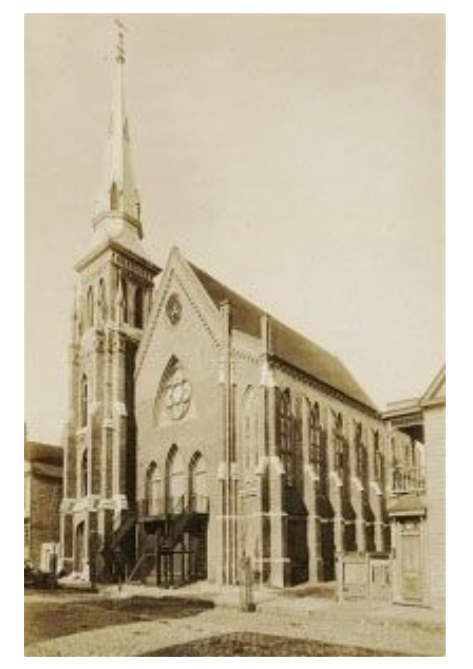
La iglesia de madera de dos pisos, construida en el sitio actual de Emanuel en 1872, resultó dañada por el devastador terremoto del 31 de agosto de 1886. La construcción de la estructura actual comenzó en la primavera de 1891 y se completó en la primavera de 1892 bajo la dirección del reverendo Lewis Ruffin Nichols por 35.000 dólares. La magnífica estructura neogótica de ladrillo, con paneles de mármol circundantes, fue redecorada y estucada entre 1949 y 1951 bajo la dirección del reverendo Frank R. Veal por un importe aproximado de 67.487 dólares. Los cuerpos del reverendo Nichols y su esposa fueron exhumados y enterrados en la base del campanario de la iglesia para que puedan estar para siempre con el Emanuel que ayudaron a criar.
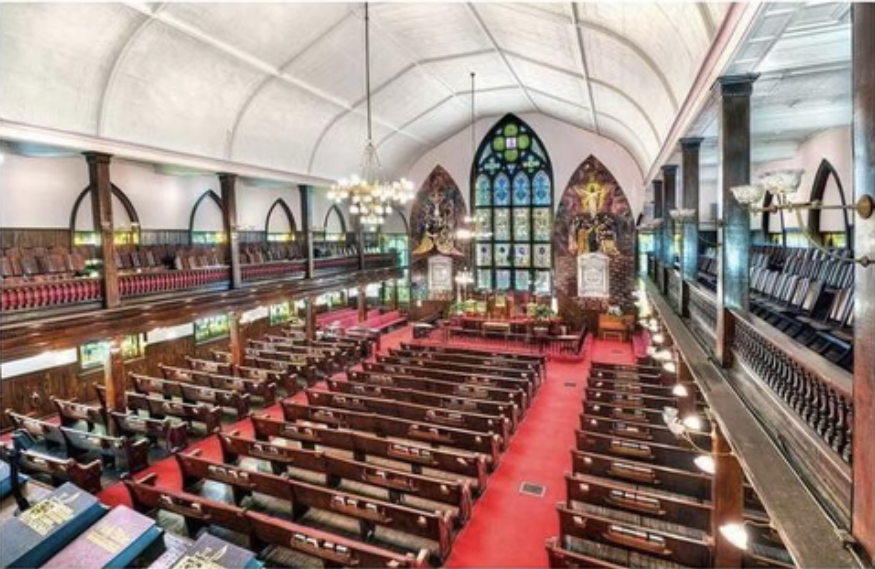
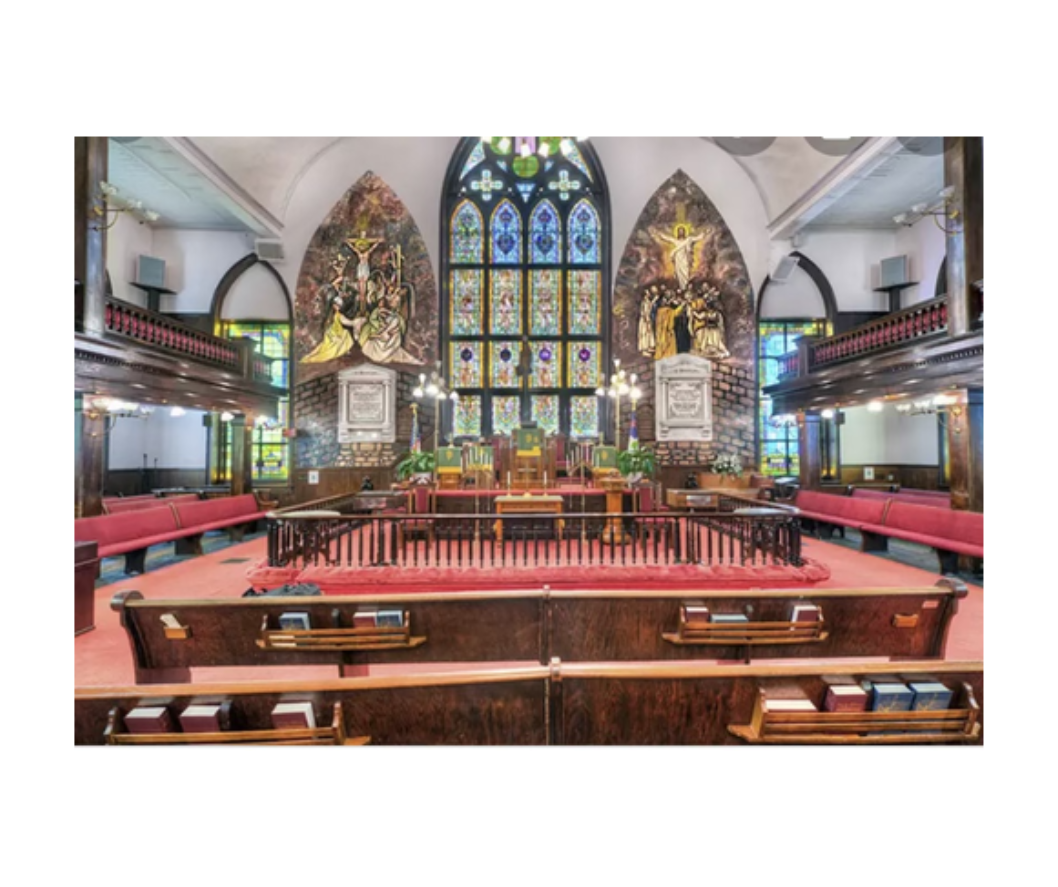
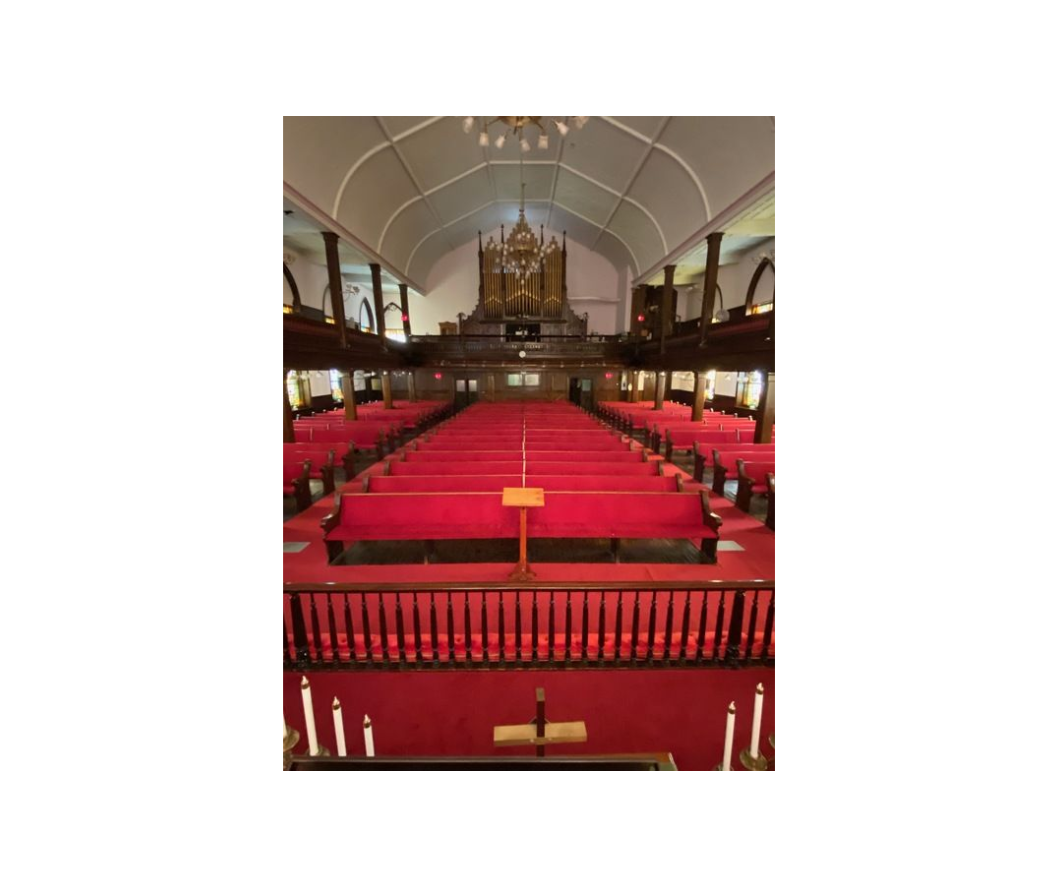
El trabajo, la dedicación y la magnífica destreza de los constructores de Emanuel son la base de la iglesia, un ejemplo monumental de esplendor arquitectónico. El exterior, de un blanco brillante con detalles en verde Charleston, recibe cálidamente a visitantes y transeúntes. A través del vestíbulo se encuentra el santuario, que alberga los bancos de madera de 1892, el altar y el suelo. Las tres lámparas de araña también datan de la electrificación original del edificio, a excepción de los globos que fueron reemplazados por los actuales en las décadas de 1950 y 1960. El enorme órgano de tubos, adquirido por 800 dólares, se inauguró en 1908 y aún hoy emite las mismas notas sonoras. Se encuentra en el coro, en la parte trasera del santuario, frente al púlpito. Las antiguas lámparas de gas se han conservado y adornan los laterales de la iglesia, por encima y por debajo de las barandillas del balcón. Una hilera de dentículos, un recurso arquitectónico predominante, se encuentra entre las dos filas de lámparas de gas a ambos lados de la iglesia. Dos murales de Cristo se encuentran a ambos lados del altar. Fueron pintados por John H. Green, artista afroamericano local, en 1945, por encargo del Club de Reparación de la iglesia. Debajo de ellos se encuentran dos monumentos de mármol en honor al obispo Richard Harvey Cain y al obispo Moses Buckingham Salter, antiguos pastores que dirigieron con dinamismo sus congregaciones. Se convirtieron en el decimocuarto y el vigésimo primer obispo, respectivamente. Un majestuoso vitral se alza entre los murales, permitiendo que la luz del sol proyecte una apacible luz tras el altar.
BE A PART OF OUR STORY
Our story is one that will inspire and encourage those who are called by God to complete extraordinary tasks.
NUESTRA HISTORIA CONTINÚA
Treinta y tres hombres (incluido Morris Brown) y una mujer sirvieron como pastores de la congregación. De los treinta y cuatro pastores, cinco se convirtieron en obispos, cinco en presidentes de universidades y uno en oficial general de la Iglesia Metodista Episcopal Africana (AME). El oficial general fue el reverendo A. W. Holman. En 1978, el reverendo Holman llegó a Emanuel procedente de la Iglesia Metodista Episcopal Africana Bethel en Georgetown, Carolina del Sur. Era originario de Lincolnville, Carolina del Sur, ciudad fundada por afroamericanos después de la Guerra Civil. El reverendo Richard H. Cain lideró el movimiento para comprar el terreno para el pueblo. El pueblo recibió su nombre en honor a Abraham Lincoln. El reverendo Holman lideró la restauración de partes de la iglesia en 1979. Fue pastor de Emanuel de 1978 a 1988. Holman regresó a Emanuel como congregante en el año 2000, tras jubilarse como director del departamento de suplementos salariales de la Iglesia Metodista Episcopal Africana. Falleció en 2004.
Un legado testamentario del Reverendo Holman donó a la iglesia algunos libros de su biblioteca personal y $5,000 para construir una estantería adecuada para los libros que abastecían la Biblioteca Conmemorativa Emanuel A. W. Holman. La estantería fue diseñada por Willi Glee y construida por Larry Imlas, de Low Country Case and Millwork. La biblioteca se inauguró el 9 de septiembre de 2018.
Como consecuencia del huracán Hugo del 21 al 22 de septiembre de 1989, Emanuel y algunas de sus propiedades sufrieron graves daños. Se gastaron más de $230,000 solo en reparaciones de la iglesia, incluyendo la sustitución de su campanario de 1903 con estructura de madera, que quedó destruido. El 26 de agosto de 1990 se inauguró un nuevo campanario con estructura de acero. Bajo el firme liderazgo del reverendo John H. Gillison, quien llegó a Emanuel en 1988, la iglesia logró una sólida recuperación tras las desastrosas consecuencias del huracán.
In December 1998, under the leadership of the Reverend Dr. William Smith, the church received a new copper-clad steeple after a year of restoration efforts. It is crowned with an operative gold-leaf weather vane. The steeple restoration cost approximately $70,000. The Reverend Dr. Smith initiated a 4 reorganization of the church infrastructure and continued improvements as we moved into the new millennium.
On Wednesday evening, June 17, 2015, after three meetings, including a Quarterly Conference, that convened back to back, beginning at 4:30 p.m., a self-acclaimed white supremacist entered the lower level of the church. He joined the pastor and eleven other members for Wednesday night Bible study. When he entered, he asked for the pastor and joined him at one of the tables. After sitting with them for about an hour, when they stood to pray as was customary when a meeting ended, the members bowed their heads. The stranger pulled out his Glock handgun and commenced to shoot them. When he finished, he had killed nine of the twelve individuals in the room. He was tried, convicted, and sentenced to death.